H1 - rotation of the milky way (tangent method)
-
most stars and gas in MW are flattened into an exponentially-decaying disk surrounding a bulge
-
if any object with mass emits light, light will trace the mass
-
it can be concluded that most of the mass is concentrated within a few kpc from the centre
-
defining an encircling radius
above with the galactic mass is constant with radius, -
so, Keplerian rotation can be used to estimate the velocity profile of the galaxy at large radii
-
equating the gravitational and centrifugal acceleration, so at
, the rotational curve of the galaxy is:
-
measuring the rotation of MW is harder than for other galaxies as earth's own motion needs to be accounted for
-
to reconstruct the rotation profile, Doppler shift in the spectra of stars, HII regions, HI, CO, etc can be measured
-
any measured Doppler shift can be converted into a radial component along the line of sight of the velocity
-
these then need to be converted into orbital velocities
-
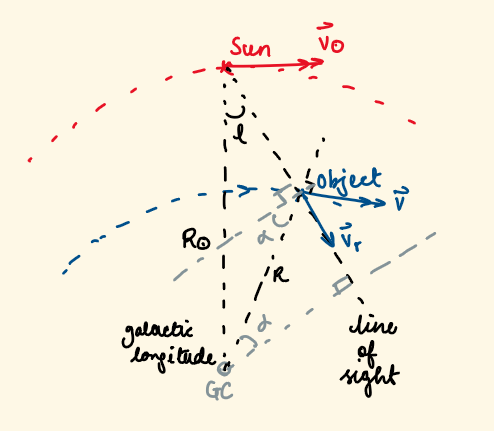
using geometry to solve for all the orbital components internal to the orbit of the sun is called the tangent method
-
geometrically:
- using the sine rule on the triangle defined by the sun, the object, and the galactic centre:
where,
- moving along the line of sight to the point where
, ie. the line of sight is tangent to the orbit:
- unless the rotational velocity increases with radius, the maximum radial velocity along the line of sight is measured at the tangent:
- note that the tangent point is only defined for
, limiting the method to galactic longitudes to between and - so, beyond sun's orbit, estimates of the rotational curve rely on different distance methods, and are more subject to uncertainty