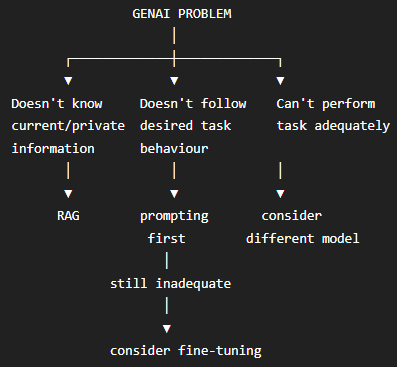
F3 - prompting, RAG & fine-tuning
prompting
-
a request can contain various pieces that do different jobs
-
system instructions establish high-level behaviour
-
eg:
You are an assistant for neutron detector engineers. Answer using the supplied technical documentation. If the documentation doesn't contain the answer, say that the available documentation is insufficient. -
conversation/user prompt is how the user provides the task
-
eg:
What is the max operating voltage of detector X? -
retrieved context
-
few-shot examples can be helpful to ensure the responses are as needed
-
eg: providing some example responses in the required format
-
it can help model infer the expected task pattern
-
prompting is usually cheap, so before building a fine-tuning dataset, try:
- clearer instructions
- explicit constraints
- output schema
- examples
- better context
- structured output mechanisms where available
RAG
DOCUMENTS
    ↓
chunk
    ↓
embed/index
    ↓
USER QUERY
    ↓
retrieve relevant chunks
    ↓
MODEL CONTEXT
    ↓
response
- RAG changes inference context, not model parameters
- the model can access updated information without being retrained every week
- it can also provide provenance, enabling applications to associate generated answers with retrieved sources
- it does not guarantee correctness
- it has at least two broad failure layers:
- retrieval, investigate: chunking, embeddings, search strategy, filters, top-k, reranking
- generation, investigate: instructions, context handling, model behaviour, grounding, model capability
fine-tuning
FOUNDATION MODEL
       +
TRAINING EXAMPLES
       ↓
additional parameter updates
       ↓
FINE-TUNED MODEL
- it changes model parameters
- fine-tuning may help adapt the model to the repeated task pattern
- it is not a database update mechanism
- it also does not eliminate RAG, they are complementay