05 - training, validation, and testing
need for three
- consider there are 10,000 detector measurements:
-
if training a model using all this, it may report an accuracy of
-
a ridiculous model may simply store the mapping of each measurement with its label, giving
accuracy -
new data is needed to measure generalisation
-
the data can be split into training and testing sets
-
when testing, the test set is run on multiple models
-
the best performing one is chosen, and further customisations and selections are performed using the same test set
-
this risks overfitting the test set
-
humans are also a part of the optimisation loop
-
if performance of a model is measured using the test set, decisions are optimised against that
-
after enough iterations, the test set is no longer genuinely independent
-
thus, a validation set is also required
-
a typical split may be
-
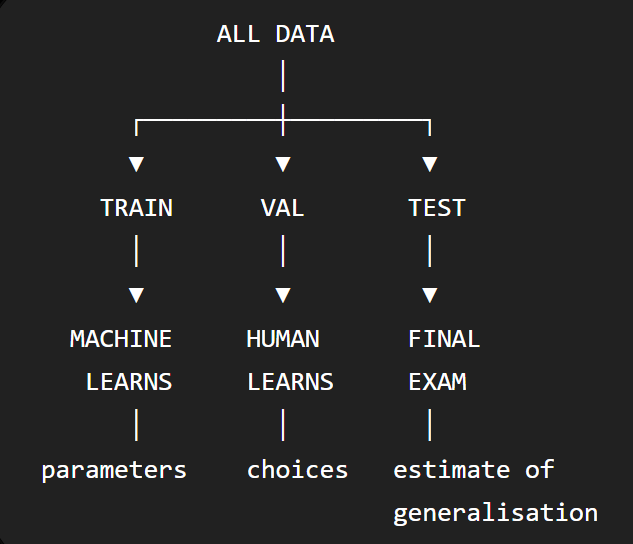
the training set is used to learn parameters:
-
the validation set is used during model development to help make modelling decisions, which might be to choose architecture, hyperparameters, regularisation, pre-processing, feature selection, or stopping point
-
the test set is used for the final unbiased evaluation
-
so the workflow becomes: build
tune make decisions freeze open test set final performance estimate -
consider
, where, parameters, and hyperparameters -
the training data approximately determines
-
the validation performance helps choose
-
the test set evaluates the final combination
TRAIN > learn parameters > MODEL > VALIDATION > choose hyper parameters > TRAIN AGAIN > VALIDATION AGAIN > ... > final model > TEST > report performance
- validation overfitting exists too
- eg: 10,000 different models/hyperparameter combinations are tried and the one with the highest validation score is selected, hence optimising against
data leakage
- information getting into model training that would not legitimately be available when making real world predictions
-
eg: target hidden in a feature like
medication_requiredin a diabetes prediction -
eg: pre-processing before splitting
- when normalising a feature
, and are calculated using train + validation + test, and then the data is split - here, the transformation applied to the training data contains information about the distribution of the test set
- it should be: train > calculate
and > fit scalar > individually transform train, validation and test - generally, anything that learn something from data should be fitted only using the appropriate training partition
- when normalising a feature
-
eg: there are 100 experiments, each generating 1,000 measurements, yielding 100,000 rows, split into 80,000 and 20,000 for training and testing
- this is a data leak as each run may have subtle unique characteristics, and the measurements from one run may be in both sets, making the test set less independent
- a better split would be experiments 1-80, 81-90 and 91-100 for train, validation and test, which is called a grouped split
-
eg: there are observations from 2022 to 2026
- a random split could result in observations from all years in both train and test sets
- the production should be PAST > train > predict FUTURE
- so a better split would be to do a temporal split by using 2022 to 2025 for training and 2026 for testing
-
a crucial limitation is that a test set does not prove universal model validity
-
eg: when a model is trained and tested using temperature data ranging from 15 to 25 degrees, it may not work well for 50
cross validation
-
cross validation is useful when there is not enough data for three sets
-
k-fold cross validation into
equal groups and do multiple rounds of training using different groups for test and train -
eg:
so there are folds 1 to 5 - round 1 train using 2 to 5, validate using 1, round 2 train using 1, 3 to 5, validate using 2, and so on
- there will be
to , so calculate the average - every observation gets used for both training and validation, but never simultaneously on the same fold while also giving a more robust estimate o performance
-
a final independent test set is still required
stratified splitting
- consider data with
failures - random splitting could produce
and failure rates in the training and testing sets, which is undesirable - a stratified split attempts to preserve class proportions yielding approximately
in both sets
important splitting patters
- an ordinary random split is done when observations are reasonably independent and identically distributed
- a stratified split is useful when class balance matters
- a grouped split is useful when observations belong to related groups
- a temporal split is useful when prediction future from past