PX153 - H4 - application of gradient in physics - the potential of a conservative force
-
similar to exact and inexact differentials
- a differential is exact if and only if:
- such that
, and there is some function, , from which this differential is based
-
for a conservative field,
, there exists a single-values scalar function of position such that (equivalent to is an exact differential), and the integral along a path between two points does not depend on the path taken -
eg: consider two charges,
and , separated by a distance, , with at the origin - the potential energy is given by:
- recall:
- coulomb force on
due to :
-
forces can be described as gradients of potentials are called conservative forces
-
the work done by a conservative force is given by the potential difference between the start(
), and the end( ), independent of the path 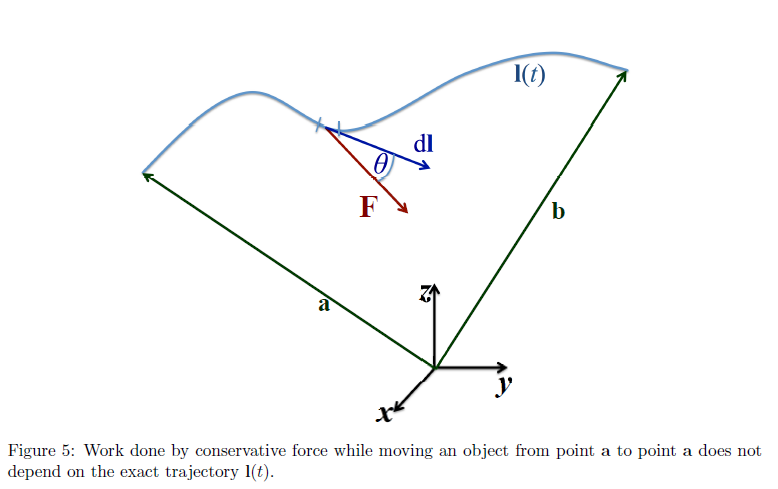
-
we have:
- can be generalised in:
- such that:
- parameterising the trajectory:
- as
, we are at ; at , we are at - then:
- assuming the force is conservative:
, and using :
- using chain rule:
- we get:
- this gives:
- ie: work done does not depend on the the path for a conservative field
- showing how to determine a scalar field from a conservative vector field
- eg: find the scalar function
, for which the vector function: , and such that - exact differential?
- if
, , and
- exact differential?