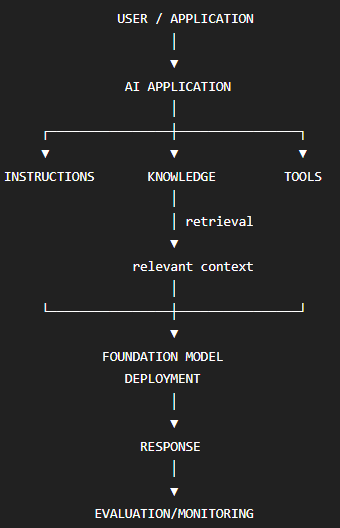
F1 - architecture
- platform for developing and operating AI apps/agents
- for GenAI, unlike classical ML, start with a pre-trained foundational model
Foundry model catalog
        ↓
select suitable model
        ↓
deploy/access model
        ↓
build application around it
-
choose according to workload requirements
-
deployment gives the application a way to invoke the selected model
-
the application then receives generated output after sending things such as:
- system instructions
- user prompt
- context
- generation configuration
-
generally, GenAI request involves:
SYSTEM INSTRUCTIONS
        +
USER MESSAGE
        +
RETRIEVED CONTEXT
        +
CONVERSATION CONTEXT
        ↓
       LLM
        ↓
generated tokens
-
LLM is just one component of the application, the other components may be:
- RAG
- prompt
- evaluation
- safety
- monitoring
-
a Foundry project provides a working context for building the AI application
FOUNDRY PROJECT
│
├── model deployments
├── application/agent development
├── evaluations
├── connections/resources
└── observability
-
the application often needs other services such as model deployment, search/index, etc, and connections/configurations allow the application to work with those resources
-
in the Microsoft stack, Azure AI Search is an important service for retrieval/indexing scenarios
-
common architecture:
-
some applications need more than simply answering the prompt, hence multiple actions/tools may be needed
-
an agent combines model reasoning with instructions, tools and state/orchestration to accomplish task
-
evaluation differs from MLOps, and is harder
-
may care about:
- grounded-ness
- relevance
- response quality
- task completion
- safety
- retrieval quality
- latency
- cost