G4 - dust emission
- emission is well described by black body radiation
- this can be quantified by establishing an equilibrium between the incident and reradiated radiation
where,
- taking an O star, with
mostly in UV, so
- using the Stefan-Boltzmann law:
- so, in equilibrium:
-
for typical values,
and pc, K -
note that
does not depend on -
typically, for galaxies with high star formation rates,
K -
using Wien's law, the peak emission would be at
m, which is the far infrared region (FIR) -
thus, galaxies with intense star formation rates should be luminous in the FIR
-
the spectra of such galaxies in detail have more structure to recognise and multiple peaks
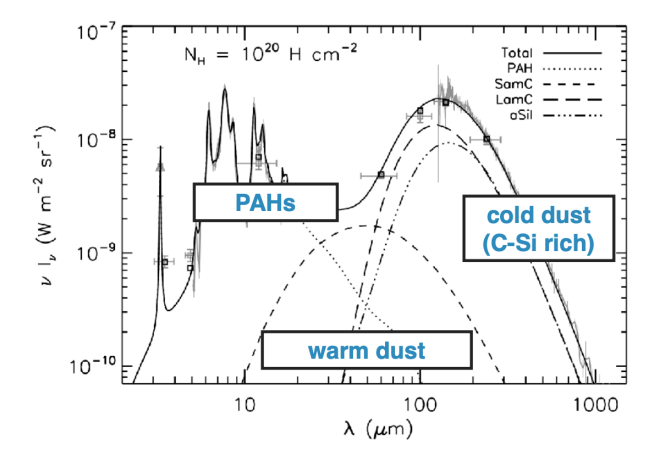
image: H Cegla, lecture notes
- at the longest wavelengths, the black body peak of cold dust, ie. similar to those derived above, with a slight shift due to a C vs Si composition
- a warm dust component, peaking around
m, describes the grains closer to the new born stars - a complex spectrum at
m arises from Polycyclic Aromatic Hydrocarbons (PAHs), - PAHs are chains of
C-H rings - they are the main reservoir of C in dust and have a prominent role in complex organic molecule formation in space
types of dusty galaxies
- dusty star-forming galaxies (DSFGs) peak at
m, meaning that the dust is headed heavily by very young stars - ultra-luminous infrared galaxies (ULIRGs) peak at
m, and are further subdivided according to their FIR luminosities, integrated between m mm - ULIRGs with
- LIRGs with
- (Hyper) HyLIRGs with
- ULIRGs with
- Sub-mm galaxies (SMGs) peak at
mm
the negative-k correction
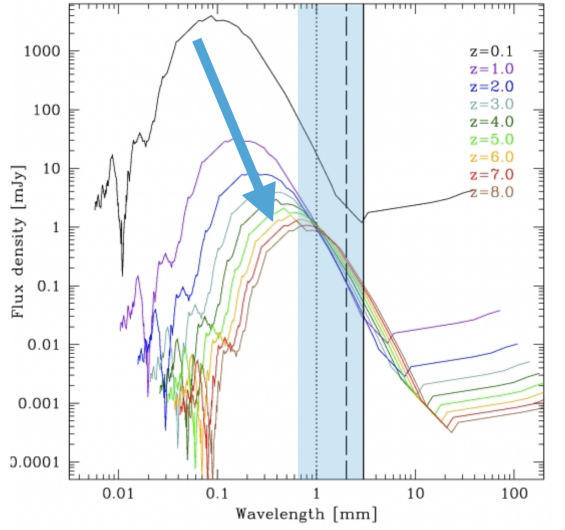
image: H Cegla, lecture notes
- Hubble flow means that recession speeds of galaxies are proportional to their distances, hence they have progressively higher redshifts
- flux from a galaxy should scale as the inverse square of the distance,
- for dusty galaxies with high IR luminosities, the flux is observed to be constant in a band around
m - but this is only an apparent effect
- dusty galaxies at large distances will have red-shifted peaks of their emissions