C3 - spirals
- composed by a nucleus and clearly visible spiral arms
- their nuclei have decreasing size down the sequence
- common in high density areas
- have red disks and blue spiral arms with more star formation
- richer in gas and dust (hence more star formation)
- produce new stars at a much higher rate

-
is the winding or pitch angle -
if
, light, Sa/SBa -
if
, loose, Sc/SBc -
can also look at the direction of rotation
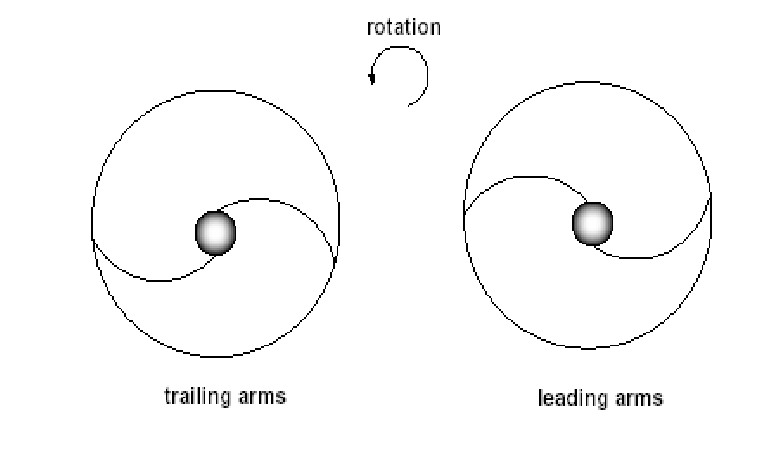
image: S Capozziello, A Lattanzi
- trailing arms
- wrap in the same direction of rotation
- outer tips point in the opposite direction
- vast majority are training, due to dynamics
- leading arms
- wrap in opposite direction
- outer tips point in the same direction
origin and stability of spiral arms
- if they are material (always formed by the same gas, dust, stars), it is easy to prove that spiral arms would not be stable over a relatively short timescales
- balancing the gravitational and centrifugal forces:
- based on the light distribution, light is localised in the galactic centre
- mass is also localised here
- if far away, assume
constant is not constant:
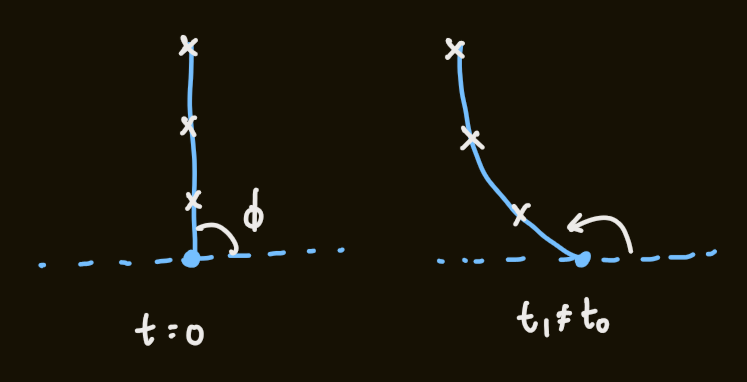
- spiral arms get wrapped up over time
- for many spirals,
is usually constant - the arc length can be approximated by a straight line,
-
considering sun's position on the MW at a distance of
kpc from the centre, km s at Gyr -
, so rad, or -
this is quite a tight spiral already, compatible with Sa/SBa
-
this is known as the winding problem
-
, or -
so, how can constant velocity be observed, and what happens to
? -
this is evidence for dark matter, however it is not enough to explain the observed constant velocity
-
so, galaxies cannot be treated as material (the same stars, gas, dust)
-
in the 1960s, Lin and Shu showed that spiral arms arise from density waves
-
density waves contain regions with higher gas and stellar densities, and are quasi stationary (evolve slowly compared to the galactic rotation)
-
stars have slightly eccentric orbits due to a non-central galactic potential
-
the the rotation rate increases with distance
-
this causes overlap and intersection of orbits, naturally leading to a kinematic spiral

image: H Cegla, lecture notes
-
self gravity reinforces the spiral and makes it stable (quasi stationary)
-
over density of gas triggers compression, and hence star formation
-
thus young blue stars of the O and B type trace spiral arms
-
the lifetimes of the O and B type stars,
, time to cross the arm -
so, they die before leaving the arm
-
new stars are formed in the mean time
-
this, young blue stars always trace spiral arms