E3 - application of cosets to permutation groups
- let
be a group of permutations of a set , then for each in , the stabiliser of in is defined as:
- so, stabiliser of an element is any permutation that keeps that element unchanged
- note:
- the set
is a subset of , called the orbit of under
-
so, it is the set of all locations a point can move to
-
eg: let
be the following subgroup of , then:
- let
be a finite group of permutations of a set , then for any from
-
by lagrange's theorem,
is the number of distinct left cosets of in -
so, it will suffice to show a one-to-one relation between the left cosets and the elements in the orbit of
, suppose -
for
to be a well defined function, need to show: -
this also means that
, so , thus, -
this reversal shows that
is one-to-one -
to show that it is onto, let
, then for some -
clearly,
, so is onto -
example: the rotation group of a cube
-
the six faces are labelled from 1 to 6, so different rotations induce different permutations of the faces, and
is group of permutations on the set -
there will be some rotation about a central, horizontal or vertical axis that carries 1 to any other, so
-
corresponds to all rotations that keep face 1 fixed, of which there are 4, about the central axis perpendicular to the face -
this,
-
after the number of rotations is known, determining the actual structure of the rotation group is simple
- the group of rotations of a cube is isomorphic to
- the order of the rotation group of a cube is the same as
- the cube has four diagonals, which are permuted by the rotations, so the consecutive diagonals are labelled 1 to 4
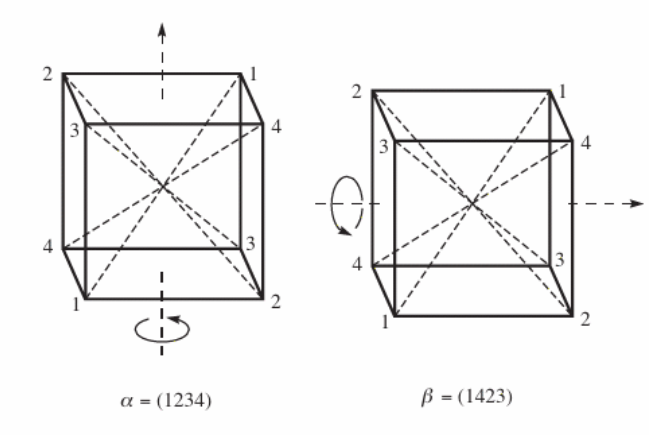
image: J. Gallian
-
a
rotation yields -
another one, perpendicular to the first axis yields
-
so, the permutation group induced by the rotations contains the 8-element subgroup
and of order -
thus, the rotations yield all 24 permutations as the order of the rotation group must be divisible by both 8 and 3
-
eg: the rotation group of a traditional soccer ball (20 regular-hexagonal and 12 regular-pentagonal faces), ie. truncated icosahedron
-
may chosen to be the set of 20 hexagons or the 12 pentagons -
say 12 pentagon set is chosen, by some rotation any one can be carried to any other, the orbit of any pentagon is
-
there are five rotations that fix any particular pentagon
-
therefore, there are 60 rotational symmetries
-
the rotation group is isomorphic to