D3 - power laws, behaviour at small radii
- surface brightness profiles often deviate from the Sersic law at very small radii, eg: close to nuclei
- they behave as a power law:
- if steeper than Sersic: cusp; if shallower: core
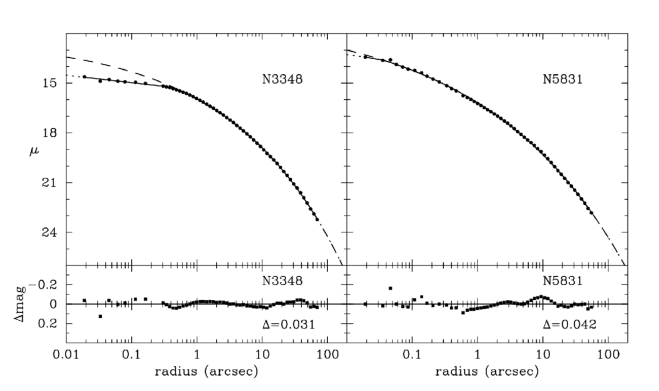
image: Graham, et al (2003)
- considering a hypothesis that the power law in the surface brightness comes from a spherical distribution of star with a density profile that is also a power law
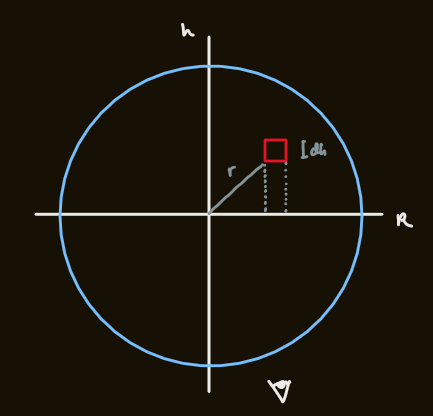
- the number density of star:
- this is valid for a constant average luminosity per star
is along the line of sight, perpendicular to - the circle defining the spherical distribution has distance
from the galactic centre
- making a change of variable
- the integral is now a number (dependent n
)
- therefore, the a spherical distribution with a power law
results in a power law in with - eg: NGC 596 with
would have with - this is a very steep distribution
- they are thought to experience circumnuclear outbursts, possibly due to gas falling onto a massive central object (SMBH), getting compressed, and triggering an episode of enhanced star formation