E3 - central regions
-
the structure and nature of the galactic centre can be understood using the stellar dynamics, ie. their orbits on the plane of the sky, and along the line of sight of the observer
-
for the former, parallax can be used
-
but is difficult to measure, and only possible for parts of the MW using GAIA
-
for the latter, Doppler shift can be used to relate the measured and rest-frame wavelengths,
, as a function of radial velocity :
- for all galaxies,
-
it will be red-shifted if
is positive (moving away), or blue-shifted if is negative (moving closer) -
two components become evident looking at the dynamics:
- bar
- SMBH
bar
- stars in the inner galactic bulge have 'boxy' orbit
- thus, they are confined within a bar-like shape
- the morphology is invisible from earth as it is viewed sideways and obscured by dust
SMBH
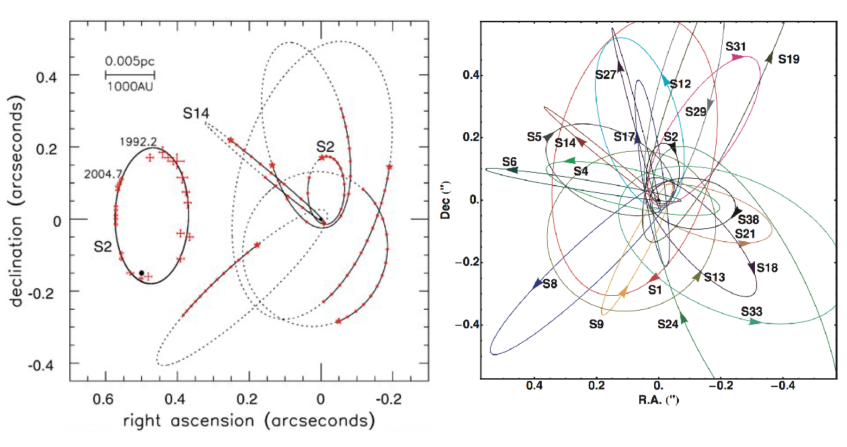
image: Eisenhauer/MPE; Gillessen, et al (2008)
- in the inner regions at distances
from the centre (radio source, Sag A*), observation of dynamics is technologically challanging - this was accomplished using adaptive optics
- stars around Sag A* were found to be moving really fast, some with orbits of only 10-15 years
- using Kepler's laws, it was found that a mass of
was confined within pc from the centre - the local mass density is
pc - the only object known with such a density is a Super-Massive Black Holes (SMBHs)