F4 - breaks
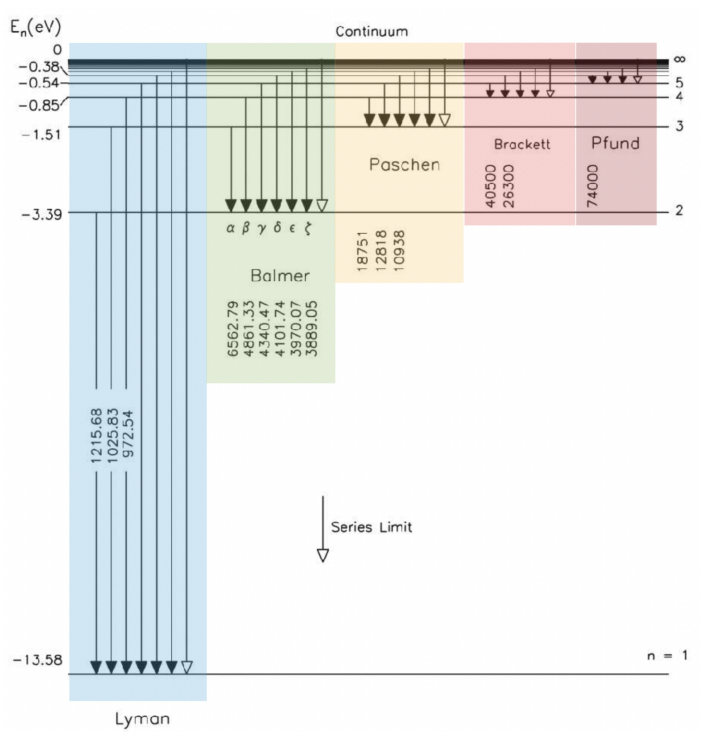
image: H Cegla, lecture notes
- H has a well known spectrum defined by the starting and ending levels (quantum number
) of the radiation emitted
| series | symbol | range | |
|---|---|---|---|
| 1 | Lyman | Ly | UV |
| 2 | Balmer | Ba/H | visible |
| 3 | Paschen | Pa | near-IR |
| 4 | Brackett | Br | IR |
| 5 | Pfund | Pf | IR |
| 6 | Humphrys | Hu | IR |
-
the transitions are indicated by Greek letter
-
the closest (lowest E) with
, for the second, -
eg:
for , Ly for -
the Rydberg formula allows the calculation of the vacuum wavelength of photons corresponding to any transition from energy level
to
where,
- the energy levels become progressive closer for growing
, asymptotically approaching the continuum level, which is eV for H - any incoming photons with energy higher than the difference between the ground state and the continuum can ionise the atom (bound-free transition)
- the spectra are a balance between neutral and ionised states
- the difference between the lowest energy of any series and the continuum energy is called the series limit
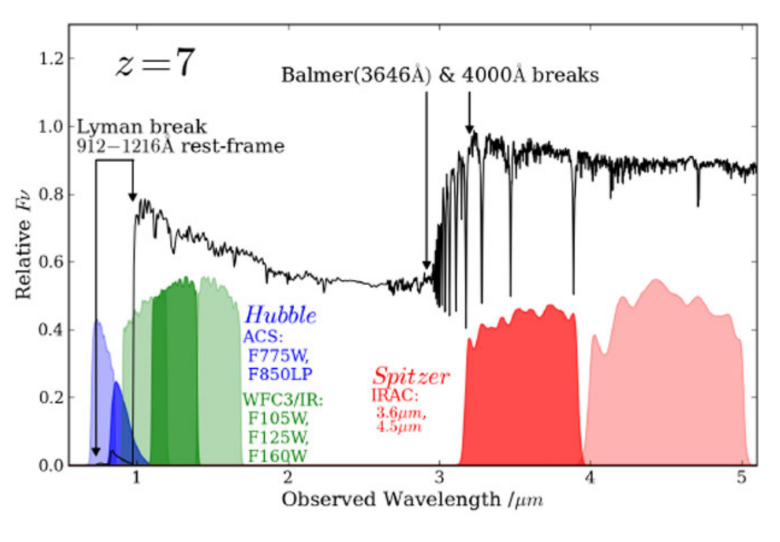
image: NASA
-
every time a series limit is approached, the spectrum shows a sharp drop in flux, called a break
- Lyman break at
angstorm - Balmer break at
angstorm
- Lyman break at
-
any photon with energy higher than the limit (shortre
) can ionise the atom -
they are therefore removed from the line of sight (absorbed or scattered) producing a drop in the measure flux
-
in order to actually see the Ly break, there has to be enough photons to start with
-
this is only possible in galaxies with recent episodes of star formation (abundant blue stars, hence UV/blue dominated spectrum)
-
the existence of Ly/Ba breaks is crucial to measure the redshift for far-away galaxies with brightness too low to see individual spectral lines
-
due to the Doppler effect:
-
the Ly/Ba breaks thus occur in the visible/IR for far away galaxies
-
at the extreme end, both can be observed in the IR (eg.
in image above)
H in star-forming regions
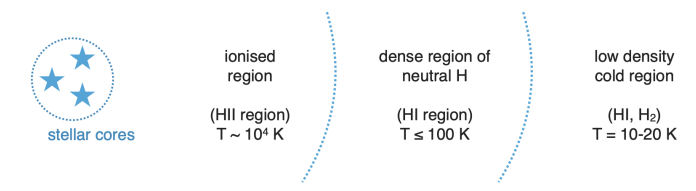
image: H Cegla, lecture notes
-
the density and temperature of H gas are considerably higher in the immediate surroundings of star-forming regions than in the rest of the ISM
-
carefully consider the balance between neutral and ionised H to understand the spectrum of star-forming regions
-
the balance is a product of:
- temperature: determines the population of energy levels
- density: drives collisions and transfers energy to atoms
- EM radiation: photons carry energy and are absorbed/emitted
-
stellar cores are young, hot, luminous precursors of stars, emitting mostly in UV
-
moving radially outward from stellar cores, all of the above decrease
-
this creates a gradient in the ionisation state of the surrounding H gas
HII region
- to find the size of a HII region, the ionisation rate can be computed as:
where,
- for type O stars,
- the ionisation process is balanced by recombination, happening at a rate:
where,
- assuming a spherical shell of radius
, and imposing a balance between the ionisation and the recombination rates:
- for any O5 star, the rate of ionisation = the rate of photons
s - typical-star forming regions have
m and m s - this results in a typical size of
pc for a HII region (similar to the distance between the sun and Proxima Cen.)
HI and radiation
- HI absorbs radiation very efficiently
- considering a distance
travelled by radiation, the change in intensity:
where,
- the source function:
- the optical depth:
- thus, the change in intensity equation can be rewritten as:
increases along the line of sight moving from the observer to the object, opposite to the natural coordinate
-
the first term is Bear-Lambert law
-
thus, the measured intensity depends on the material composition through
, and the total absorption through -
considering two limiting cases
-
optically thick medium
-
so there is no information about the original path of the radiation
-
only the 'surface' of the material is visible
-
similar to how only the first treeline is visible when looking at a thick forest
-
optically thin medium
-
so the intensity is proportional to the total absorption along the line of sight