B6b - finite difference
- spatial discretisation uses centred method, forward time centred space (FTCS) scheme
- using the same fourier method as before, it can be shown that this scheme is consistent in time
- but it needs to be shown that this is stable
- the plane wave solution exists, so analytically, it is stable
- using fourier representation:
where,
- considering one mode:
- the amplification factor, which is the ratio of fourier amplitudes at
and needs to be found to see if the mode is growing or decaying
- when
, there is instability - since the
, the scheme is unstable - the most unstable mode is when
- a solution would be to take a very small
, which is impractical - however, a small damping can be added
damping
- the artificial last term needs to be sufficiently small so that the scheme is consistent
must scale with and
- this can be analysed graphically
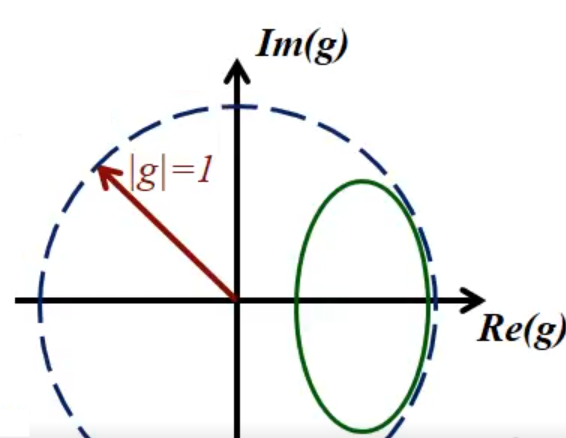
image: B Hnat, lecture notes
- the wanted complex amplification factor,
, is within the blue dashed circle - for a given
, is an ellipse - the important behaviour is near
- got the green ellipse to be within enclosed within the blue circle, their curvatures near
need to be matched for small - the small
limit is found using taylor expansion of and around
- for
, the second term in the square bracket must be greater than the first:
- this approach of adding a sufficiently large damping is called lax-wendroff scheme
- unfortunately, it generates false oscillations near sharp features, which can cause problems, especially for strictly positive quantities